ISTE and Belonging

ISTE20 conference is now November 28-December 1 in Anaheim, California

ISTE 2019 poster with various pics from the conference

This weekend, I and at least 15,000 other educators and exhibitors should be attending the ISTE conference in Anaheim, California. But, as we all know, that’s not happening due to current circumstances. I have been seeing posts on social media by my PLN with photos of past ISTE conferences they attended which are showing up in their “memories”. Each and every one of the posts exclaim their sadness at missing this very special time with other innovative and passionate educators who are also a bit flaky (and I say that in the most loving way). I also thought about posting photo memories on my feed, but ISTE is more than just a one-time memory. ISTE is a community where so many of us feel like we belong. So I began to wonder what it is about ISTE that makes so many of us feel that way. It all relates to feeling accepted and a strong sense of belonging.

In 2016, when I was still mostly a lurker on Twitter I came across a post by someone in my PLN (honestly I would give credit here, but I don’t remember) who was #notatISTE and posted links to live streaming of some sessions at the conference. As I watched, I felt this strong connection to those attending. I also found #passtheschopeEDU was interviewing attendees which gave me an inside look at all the activities that happen during the conference. I was hooked! and made up my mind that I would join right away and attend the 2017 conference in El Paso, Texas. Looking back, I realize that it was a life-changing moment which opened up my world to edtech, amazing people to add to my PLN, and moved me out of my comfort zone.
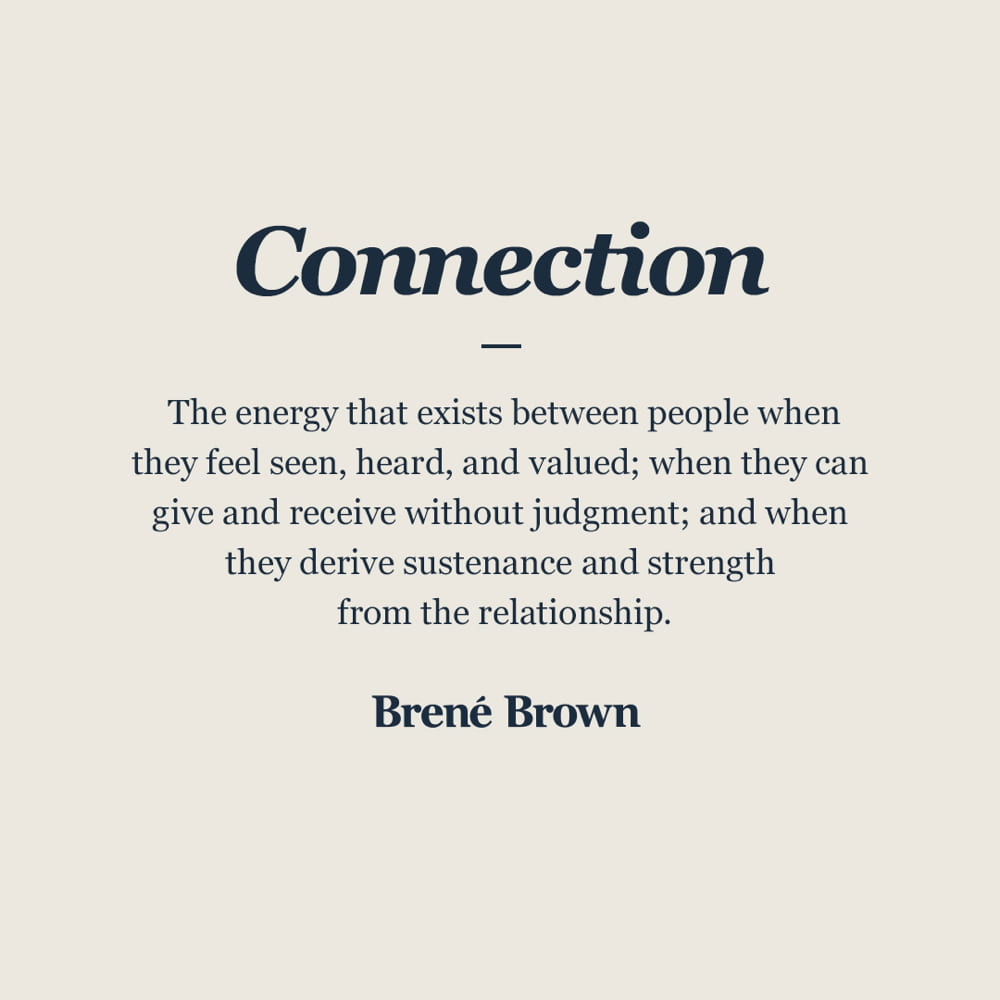
Quote from Brene Brown-Definition of Connection

People don’t usually move out of their comfort zones unless they feel welcome, included, and accepted. Finding a sense of self-belonging within ISTE meant I had to gain confidence and feel accepted for my lack of knowledge about edtech but willingness to learn. I found all of that and more among the ISTE community. Alison Taplay, in a blog post from October, 2018 writes, “(Belonging) is a feeling of connection to others and a connection to place. It means feeling welcomed and accepted. It means feeling safe enough to be me; to show up and contribute! When everyone in a community experiences this sense of belonging, there is a natural shift toward an attitude of taking care of one another.”

GCN Leadership team members 2019-2020

During the year leading up to the 2017 conference, I began to follow others who were involved in edtech and ISTE PLNs. I made sure I received the regular newsletters and updates from ISTE and my ISTE PLNs. I added my name to the Global Collaboration Network and indicated my interest in volunteering for the leadership team; I became an at large member and loved attending the synchronous meetings and supporting the planning of conference activities like the Playground and Scavenger Hunt. I got to know the rest of the team and learned so much from them. In addition, I added my name to the ISTE17 group and learned how to make the most out of the conference (it’s packed with so many things going on at once that it’s easy to get overwhelmed and FOMO if you’re not careful). All of this made me feel valued. Everyone needs to feel valued.

upper right: Leigh, Barbara and me; lower right: Scavenger Hunt team “WonderWomen”

In June 2017 I attended the conference in San Antonio, Texas. ISTE17 was daunting, but I was determined to meet people and make the most of my five day experience. The Badge Summit was my first day. I have always been interested in digital badges as a way to show competency mastery for personal and professional development. I had no idea that I would meet someone I had been following for a while and admired for her knowledge and caring about education and educators. That special person is Barbara Bray. Barbara saw me sitting alone at one of the Badge Summit sessions and, as she told me later, she dislikes seeing anyone sit alone. She joined me at my table and we struck up a conversation. If you know Barbara, you know that it’s immensely difficult to resist chatting with her. She is one of the nicest and friendliest people you will ever meet and so good at networking! After the session finished, she asked if I’d like to join her to attend a special event later that evening. I was thrilled and felt so honored. Here was someone I considered an education icon asking me to join her. I’m quite shy and introverted, so my answer normally would have been, “That’s really nice, but I think I’ll just go back to the hotel.” However, there was something about Barbara that made me feel like we had known each other forever. It was the beginning of our friendship and sisterhood. We’ve been roommates at ISTE since then and keep in touch often even though she’s in California and I’m in Kuwait.

From left: Barbara and me goofing around; upper right: my PLN circle; lower right: passthescopeEDU 4 year anniversary poster

There is something else about Barbara that I want to mention here. She opened doors for me to go through that I never would have had the courage to enter. She connected me with other amazing and caring educators who helped me grow over the past three years. When you’re at ISTE, there are thousands of people around you, but if you recognize someone you’ve been following on social media, time slows down and as you bound across the room to give that person a hug, they welcome you and make you feel special too. Besides the amazing networking opportunities at ISTE, there are a variety of sessions and special events like Flipgrid Live and EdTech Karaoke. But probably my favorite is the GCN Scavenger Hunt. Barbara and I teamed up with three other amazing women, Heidi Carr, Melissa Eddington, and Christy Cate. Even my children were surprised at the things I was willing to do like making a pyramid with the rest of my team (like cheerleaders do), or asking a stranger who sort of looked like me to pose for a photo (in the middle of Chicago’s Chinatown). I don’t think I’ve ever had that much fun!
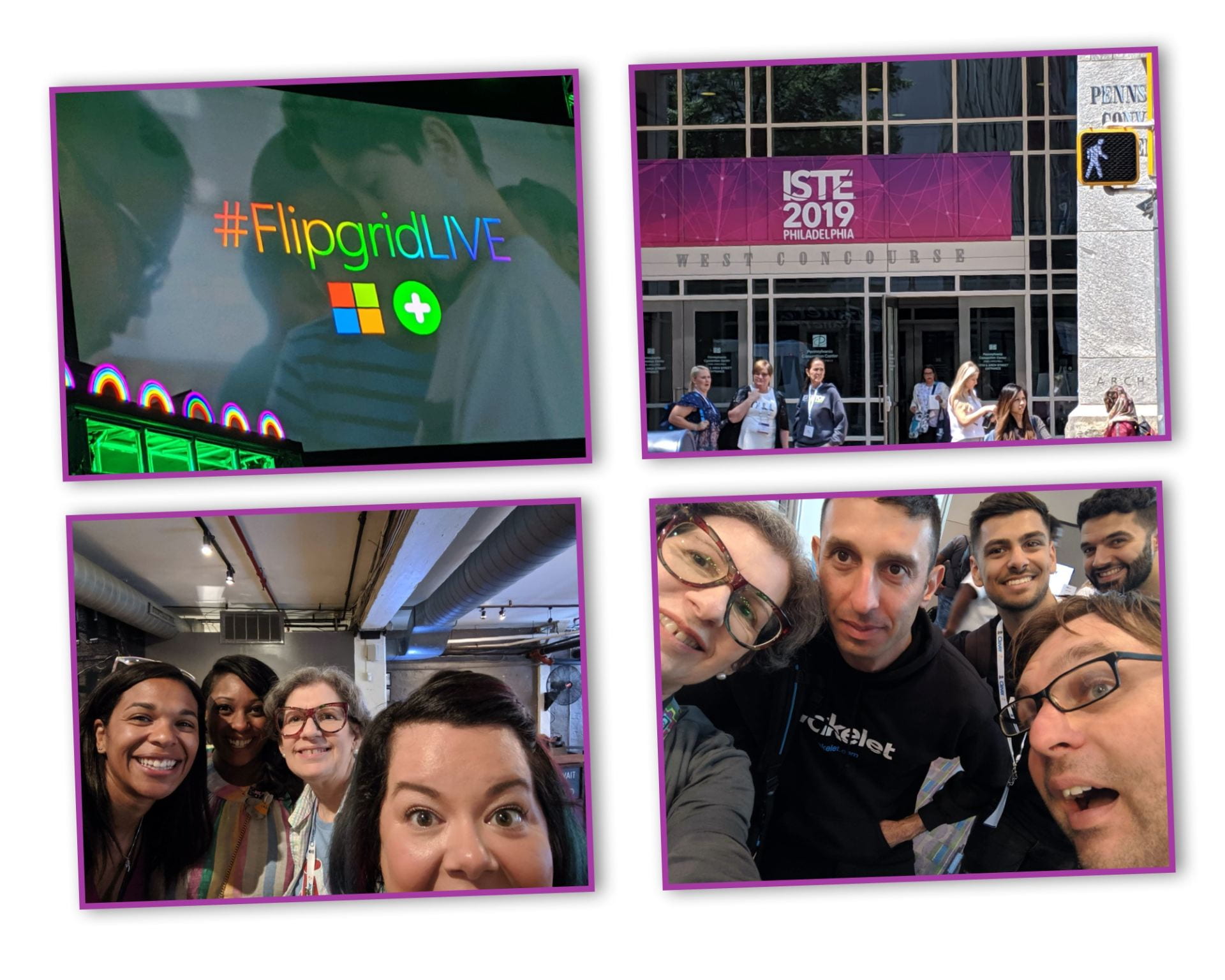
Upper right: Flipgrid Live 2019; lower right: Jess, Jornea, Ann from Fipgrid selfie with me; upper right: ISTE 2019 sign on Philadelphia Convention Center; lower right: Ilene and Michael Harvey (GCN team) with Misbah and Jamil of Wakelet

In 2018, I became the president-elect of the Global Collaboration Network and just finished my year as President. With so many of our team in different time zones, scheduling synchronous meetings wasn’t easy, but we managed to meet four times and also became active users of Slack (something else I learned about-thank you Simon Helton). ISTE strives to be more international and has members all over the world. They also organize training in the ISTE standards in a variety of venues globally to ensure digital citizenship and equity happens everywhere. Besides stepping out of my comfort zone to join the GCN team and have the courage to network like my mentor, Barbara, I have also started blogging and podcasting about my journey to belonging.

ISTE members welcomed me with open arms and created the opportunity to meet so many awesome people who have made such a difference in my life. Because I feel like I have people I can count on for support at any time, I continue to venture out of my comfort zone. I’m more active on social media and speak out about causes I believe in. I am also learning how to use apps and showing others how to use them. At ISTE, Sharing definitely does mean Caring! A membership in ISTE is a gift that keeps on giving.

My website, podcast, and social media details.

I am not as “woke” as I thought I was

Uplift Town Hall about Black creatives with disabilties

Last week, was a momentous week for me. I learned so much and expanded my knowledge by listening to the voices of other people. My eyes were opened to new ways of looking at different faiths and the precarious world that Black artists with disabilities experience. I listened to those voices while I attended two amazing webinars. The first webinar was an interview of Rabbi David Rosen by founder of the Inter-Heart organization in Kuwait, Nejoud Al Yagout. The second was a series of interviews by Stephanie Thomas founder and CEO of Cur8able with six creatives, Tatiana Lee, Lauren (Lolo) Spencer, Natalie Trevonne, Shaheem, Richard Bell, and Wesley Hamilton. The host and organizer of this truly inclusive event, Marisa Hamamoto is the Founder, CEO, and Artistic Director of Infinite Flow – An Inclusive Dance Company. In today’s post, I want to share my biggest “take aways” from each of these groundbreaking webinars.

Rabbi David Rosen and Nejoud Al Yagout during the Inter-Heart interview

Nejoud Al Yagout is a Kuwaiti author and poet. I recently interviewed her for my podcast, Journey’s to Belonging. She started Inter-Heart because she believes “we are here to befriend one another and absorb the wisdom of each others’ scriptures and engage in love”. Rabbi Brown was the Chief Rabbi of Ireland and the senior rabbi of the largest Orthodox Jewish Congregation in South Africa and is currently the International Director of Interreligious Affairs at the American Jewish Committee. He serves on the board of the KAICIID International Dialogue Center based in Saudi Arabia as the representative of the Jewish faith. In February 2020, Rabbi Rosen attended an interfaith meeting in Saudi Arabia to discuss a way forward for peace and understanding among all religions around the world. Nejoud’s interview was unusual because, although there was a small Jewish population in Kuwait before 1948, there is no longer open representation. Nejoud’s Inter-Heart organization hopes to break down barriers and misunderstandings people have about other religions. Rabbi Rosen was senior rabbi in South Africa during apartheid. It was during this time that he listened and learned how to bring different communities together.

Some of my key “learning” from the hour long interview are:

If I want to be understood, I need to understand others
If God created diversity there must be a reason for it
Interfaith work is a wonderful gift of spiritual significance
We are limited in comprehension to our own place
A holy person is a spiritually modest person
Human solidarity=humanity
Truly spiritual people should be vegan
The more we see the divine in one another, the more we can be better to each other
There is a clear link between racism and religious bigotry
In order to help people understand each other, get them to work together on action projects and joint projects

The second webinar I attended was called Uplift. Marialice Curran (@mbfxc on Twitter), an advocate for assistive technologies, inclusion, and digital citizenship let my PLN know about this wonderful experience. The webinar was organized by Marisa Hamamoto on Zoom. Marisa made sure there were ASL interpreters, closed captions, and that the attendees were aware that we needed to be patient as all aspects were worked out to ensure maximum inclusivity for everyone. In fact, there was a small delay at the start due to technical difficulties since they needed to switch between the two ASL interpreters (Caroline Blaike and Angelie Thomas) and make sure closed captioning worked. After a short delay (Marisa was so gracious the entire time), she introduced Stephanie who spoke about her own struggles in the fashion industry as a Black creative with disability. Then we listened as Stephanie introduced and interviewed an amazing group of artists involved in many different industries and media. Each disability was overcome through perseverance and courage. But there are still obstacles including being the only Black person in the space. Each of their stories was inspiring and shows how I need to be more aware of the challenges related too being disabled and how much harder each of them worked to carve out their unique place in the arts.

The interviews were such a learning experience for me, but I was even more impressed by the amount of effort taken to ensure the Zoom meeting was inclusive and allowed them to express themselves, either through sign language interpreters or closed captioning. I am sure there was a lot more that happened “behind the scenes” to get everyone and everything set for the webinar. I credit Marisa with the idea and her awesomeness at facilitating it all.

After watching Uplift 1, I made a small donation to Infinite Flow an inclusive and innovative dance organization founded in 2015 by Marisa Hamamoto, who survived a stroke that initially paralyzed her from the neck down. Infinite Flow is the first wheelchair ballroom dance company in America. The dancers are abled and disabled. She books groups to visit elementary schools to inspire and educate children about living with a disability. I highly suggest visiting their website (https://www.infiniteflowdance.org) and finding out more.

The current global move of #BlackLivesMatter protests and my own awareness that although I consider myself an ally and “woke”, there is still a lot I don’t know. I am spending this time listening, watching, reading, and learning as I evaluate my own knowledge of inclusivity and equity. I am questioning and being mindful of not getting overconfident that i know as much or more than others with white privilege even though I have #goodancestors. I am also looking for ways I can be more outspoken and supportive to upend the colonialized and institutionalized systems of racism, wherever and whenever it is found.

Screaming on the inside, looking for solutions on the outside

“In the end, we will not remember the words of our enemies, but the silence of our friends.”
Dr. Martin Luther King, Jr.

I cannot remain silent. I will never be silent in the face of racism, prejudice, bullying, discrimination!

I join with all others and scream out to those who contribute to the perpetuation of racism and all other “isms”; READ, LEARN, THINK, REFLECT.

I will speak out against racism wherever and whenever it happens; in America or Kuwait or Europe or…

I lived through the 1960s and remember the backlash against the Civil Rights movement. I remember the riots and rhetoric. It was a significant time in my life and my parents were highly involved in searching for solutions and speaking up. If I stay silent now or ever, I will be disrespecting their legacy. A legacy of tolerance, justice, understanding, and activism.

My father was a Superintendent in the New York State Department of Labor for the Western New York area. His job included seeking job opportunities for minorities (so labeled at the time) and ensuring equality in hiring practices. A trained lawyer, my father was a volunteer at the Buffalo Volunteer Law Project after he retired from public service and represented clients who couldn’t afford representation. He and my mother were members of the National Association for the Advancement of Colored People (NAACP) whose mission is “to secure the political, educational, social, and economic equality of rights in order to eliminate race-based discrimination and ensure the health and well-being of all persons.”

My family and I regularly discussed issues of race and racism and religious discrimination at our dinner table. We were acutely aware of the latter because as a Jewish family in a majority Christian neighborhood, we advocated for equal representation at school music concerts and to have our major holidays recognized as legal holidays.

My mother was a political activist as early as the 1950s. After moving to Buffalo from Long Island, she became involved with the original group that formed the National Women’s Political Caucus. She enrolled in the first Women’s Studies course at SUNY Buffalo in 1971; Women and Contemporary Society. But we also knew we were privileged. We had a roof over our heads, food on our table, clothing to wear, and went on to enroll in university. Stories that my parents told us, were examples to my siblings and me that we had to be aware there were many who weren’t advantaged like we were.

In years past, people asked if we remember where we were when we heard the President John F. Kennedy was assassinated. Yes. I remember where I was on November 22, 1961. I also remember where I was when I found out that Reverend Martin Luther King Jr. was assassinated on April 4, 1968. Hearing the recording of his “I have a dream” speech still makes me cry. Why? Because racism is still prevalent in this world; after more than 50 years of struggle and sacrifice by many!

So what is my message to everyone today? Read, listen, and learn about the history of racist behaviors and racism in the world. Find ways to support causes that work towards equality and against racism. Think about how we lose our own humanity each time someone is threatened, bullied, discriminated against, or murdered because of their race or religion or gender, or ethnicity.

Why does it matter to me? Other than it is embedded in my upbringing, my immediate family includes different religious faiths, gender identities, ethnicities, and skin colors. I was raised Jewish, but converted to Islam before I got married in 1984. My marriage is intercultural and inter-racial. My children are biracial and brown. My sons-in-law are biracial Hispanic and American heritage. My daughter-in-law has Arab roots that also include Jordanian-Palestinian. Has it been easy to live as a family with so many different races, faiths, and ethnicities? Hardly. But each member, including my parents, my siblings, my children, their spouses, and their cousins have worked very hard to recognize that we are still family. We respect each other and hold each other equal. But most importantly, and this includes ME, we listen to each other and continue to learn from each other about our different faiths, ethnicities, gender identities, and race.

On a professional level, as a third grade teacher, I encountered perceived racism in my classroom between students of different Arab heritage. One of my students was very upset and told me she felt excluded when her classmates were outside at recess or working on group activities. Although I didn’t observe these behaviors, I relied on her feelings about the situation and not my assessment of what I thought was or wasn’t happening to her. She felt excluded during activities from the majority of students. She believed she wasn’t included because she was different. I included team building activities in my planning and made sure to manage groups during independent work times to ensure everyone felt included and valued. I also checked in with my students individually to make sure each was comfortable in our classroom.

I had another encounter with racism as director of a foundation program at a private university. A student came to my office and asked to move to a different section. When I asked her the reason for her request, she told me she was receiving messages from other students that made her feel unwanted. I spoke with her instructor who told me there was some interaction among her students that led to a misunderstanding but she was handling it. However, after the second incident was reported to me by the same student, I went into the class, with the instructor’s and student’s permission, and spoke with the whole class. I used examples from my own life; that when I was a student, I felt different and it impacted my ability to learn. We sat and discussed how to make things better for the student who felt marginalized and how to ensure inclusivity and awareness of how our behaviors negatively affect others.

I write and speak about belonging and how children can feel isolated like an outsider if we aren’t aware of the dynamics different races or socio-economic levels create among our students. We must listen and find out how students are feeling. We must act to minimize and eliminate barriers to learning due to racism or any other type of “ism”.

And one final note about words and speaking out: A few months ago, I replied to a tweet by shea martin (@sheathescholar) with the intention of supporting them because I asked them to explain. One of their friends on Twitter replied to me that I should take responsibility for finding out about the topic and that it was exhausting for shea or any other person experiencing a lack of understanding about their race, gender, faith to continuously have to educate me and others. Of course, I apologized and have since done more reading about the topic of gender identity. The reason I mention this here is to underline my responsibility and our responsibility as a community to read and research about gender identity, race, religious faith. I’ve seen quite a few posts this past week reiterating that it is the responsibility of each and every one of us who is privileged to find out more, read more, do more to know more and better understand how to be anti-racist and become an activist by speaking against racism and all the ‘isms’. I am constantly learning.

I am including some links to resources but there are many others.
https://www.leadingequitycenter.com
https://www.goodgoodgood.co/anti-racism-resources
https://www.naacp.org/about-us/game-changers
https://www.history.com/topics/black-history/civil-rights-movement#section_8