
Reading Culture or Reading Program?

Young children listen to the teacher as she read a book aloud.  Photo credit: Yan Krukov

Staffroom podcast episode 105: Setting Up a Culture of Reading

Last week, I listened to the latest Staffroom Podcast episode with Chey Cheyney and Pav Wander. Their posts on Twitter about the episode immediately caught my attention because of my experience in Kuwait teaching English language learners. I have strong opinions about how children learn how to read based on my teaching experience with third-grade English learners. When I began teaching, I needed to know more about teaching English language learners, so I read the current research. I also know what worked and didn’t work for my own children and for me when I was learning to read.

As I listened to Chey and Pav’s lively discussion that included topics such as a culture of reading or a reading program, a balanced literacy approach, and the science of reading, I remembered something that happened to my son. Chey mentioned whether being astutely proficient or having been taught all of the reading skills was necessary for every student. That is, do we have to know every reading skill to read at a proficient level? And where does a love of reading fit in? Pav responded that reading doesn’t come naturally according to the research. This topic resonated with me deeply and I have a personal story about my son’s experience in middle school. I will share his story and then some of the most recent science about learning how to read. 

7th grade   

By the time my son started 7th grade, he was a prolific reader. The Hobbit, Lord of the Rings Trilogy, any new book by Brian Jacques; all of them over 300 pages. Although his father’s first language is Arabic and we live in Kuwait, my son has always been more fluent in English and speaks, writes, and reads like a native speaker. Or, so I thought until he came home in November of that year with a “D” on his most recent essay. My philosophy about supporting my children with their homework was hands-off once they were in middle school and could ask me for help if they needed it, so this was the first time I’d seen his essay. It was also the first time he’d received such a poor grade on any of his school work. Once I read through his essay, I knew what the problem was. He had only a superficial understanding of the book he had read. This was definitely a revelation for me. I had always assumed that my son understood at a high level of comprehension and now I found out he didn’t. 

I sat down to discuss the problem with my son and we looked at a few passages from the book. I asked him some deeper questions about the characters and plot which he struggled to answer! I told him I wanted to call his school and meet with his teacher. My son agreed that it was a good idea. When I sat down with his English teacher, she told me that my son was a very good student overall. I asked her how a native speaker like my son could reach 7th grade with such a poor level of comprehension. She told me that the majority of the students in his grade level were weak in their English skills and she was teaching to the majority of the class. She blamed it on the lack of English language support staff in the middle school. Of course, that was not the answer I wanted to hear, nor was it acceptable as far as I was concerned. I arranged a meeting with the middle school principal and he repeated what the teacher had told me. I could see I wasn’t going to get anywhere with the school and realized I needed to get involved with my son’s schoolwork, especially in the area of reading comprehension. His level of vocabulary was way above his classmates, but he was only reading superficially. 

From that time, and until he entered high school, I would ask him questions about what he was reading in various subjects. We started with the basics such as plot, characters, and themes. In subjects other than English, he used his prior knowledge to inform, analyze, and synthesize his new learning. If he was interested in discussing his pleasure reading with me, I was happy to chat with him about it; however, I didn’t want to make it seem like another task. If you’re familiar with  Bloom’s taxonomy, you will recognize how I prompted my son to think at higher cognitive levels than understanding which is one of the lowest forms of cognition. My son’s responses to my questions over time showed me that his reading comprehension had improved by leaps and bounds. In fact, his verbal scores on the SAT were in one of the highest percentiles. He is now in his early 30s and working in a job that requires him to think strategically and creatively. His love of reading has not abated and you rarely see him without his Kindle. 

Mother reading and showing a book to her baby daughter. Photo credit: William Fortunato

Explicit instruction, pleasure reading, and creating a culture of reading

Reading instruction that is developmentally appropriate has been studied for many years. However, it is only recently that we have the fMRI technology of brain scans to understand how the brain learns to read. Speaking comes naturally to us, but reading must be taught. How it is taught is very important. According to research cited in a 2019 article in Education Week, “Decades of research have shown that explicit phonics instruction benefits early readers, but particularly those who struggle to read.” It goes on to say that children who are not explicitly taught sound/letter recognition (in an alphabetically-based language like English or Spanish), will struggle with comprehension later on due to the lack of automaticity in decoding text. This is something that I learned in relation to struggling English language learners in Kuwait and is supported by the research. The slower you read and the longer it takes you to decode a sentence, the more likely you are to struggle with comprehension of what you read. 

However, not all phonics instruction is equally successful. It must be systematic, according to the National Reading Panel (2000), and supported by other research reviews: 

A systematic phonics program teaches an ordered progression of letter-sound correspondences. Teachers don’t only address the letter-sound connections that students stumble over. Instead, they address all of the combinations methodically, in a sequence, moving on to the next once students demonstrate mastery. Teachers explicitly tell students what sounds correspond to what letter patterns, rather than asking students to figure it out on their own or make guesses.

An experiment by a neuroscientist at Stanford (2015) with a made-up language supports the systematic approach of teaching phonics rather than expecting students to guess at the words after being instructed using sight words. English learners and students with disabilities benefit from systematic phonics instruction at the kindergarten and grade 1 levels. The association between phonics instruction and reading comprehension is clear. 

In terms of balanced literacy which was another topic mentioned by Chey and Pav during the episode, the research has shown that using context clues or other cues to decode a word slows the reader down. I’m not sure this is totally the case since there are times when students, especially language learners, need extra help from the text to determine meaning, thus supporting their comprehension. It’s also another way for them to engage with the text because they have to focus all the time on what they’re reading. 

The Education Week article (2019) relies heavily on the National Reading Panel Executive Summary (2000) that underlines the importance of teaching phonemes and graphemes (systematic phonics) in grade 1 and other reading skills that support automaticity of decoding and comprehension. For more detail, a link to the article is in the references below. However, Bowers (2020) has done a meta-analysis of numerous studies over a period of 20 years that showed studies noted, “Nevertheless, despite this strong consensus, I will show that there is little or no evidence that systematic phonics is better than the main alternative methods used in schools, including whole language and balanced literacy”.  Hence, something known as the “reading wars”. 

In support of systematic phonics instruction, one meta-analysis of reading intervention studies finds that phonics-focused interventions were most effective through grade 1; in older grades—when most students will have mastered phonics—interventions that targeted comprehension or a mix of reading skills showed bigger effects on students’ reading skills. (Suggate, 2010) Another study, however, has looked at the three main approaches to teaching reading: systematics phonics instruction, whole language, and balanced literacy which is a combination of whole language and non-systematic phonics instruction, and Bowers (2020) concluded it “should not be that we should be satisfied with either systematic phonics or whole language, but rather teachers and researchers should consider alternative methods of reading instruction”.  

All in all, the science of reading supports the need for explicit instruction at an early age at the appropriate stage of development. My experience, although non-scientific, supports a combination of systematic instruction along with reading for meaning within the context and using how words are formed. So for early years including preschool and kindergarten, “the National Early Literacy Panel found that both reading books to young children and engaging in activities aimed at improving their language development improved their oral language skills (2008).” 

Spoken language is also important in the very early years and research shows that the more vocabulary young children are exposed to and the more able they are to communicate verbally, the better they are at reading and comprehending. When books are read aloud or print is pointed out to them (such as signage, labels, etc.), they begin to associate sounds with letters and how the printed word works. They also begin to learn about books and print which increases their ability to learn grammar and syntax faster as they develop more skills in higher grades.  

The weekly Staffroom episodes discuss a variety of topics and always challenge my thinking. I really appreciate and enjoy the interaction by Chey and Pav during the show and the conversations on social media by other educators who are listening. 

Link to the show: https://www.cheyandpav.com

Link to Episode 105: https://www.cheyandpav.com and at https://voiced.ca/podcast_episode_post/203-chey-pav-and-the-staffroom-podcast 

References 

Bowers, J.S. (8 January 2020). Reconsidering the evidence that systematic phonics is more effective than alternative methods of reading instruction. Educational Psychology Review. https://link.springer.com/article/10.1007/s10648-019-09515-y

Early Literacy Panel. (2008). Developing early literacy: Report of the national early literacy panel. https://lincs.ed.gov/publications/pdf/NELPReport09.pdf

National Reading Panel. (2000). Teaching children to read: An evidence-based assessment of the scientific research literature on reading and its implications for reading instruction [Executive summary]

Schwartz, S. & Sparks, S.D. (2019). How do kids learn to read: What the science says. Education Week.https://www.edweek.org/teaching-learning/how-do-kids-learn-to-read-what-the-scence-says/2019/10

Suggate, S. P. (2010). Why what we teach depends on when: grade and reading intervention modality moderate effect size. Developmental Psychology. https://pubmed.ncbi.nlm.nih.gov/20873927

Youncheva, Y., Wise, J. & McCandliss, B. (16 May 2015). Hemispheric specialization for visual words Is shaped by attention to sublexical units during initial learning. Brain Language. 

For an interesting opinion piece on the science of reading and so-called reading wars: https://www.washingtonpost.com/education/2021/01/26/readingwars-scienceofreading-teaching​​

Self-belonging

The journey to true belonging begins with self-belonging. -Ilene Winokur

School experiences can have a long-lasting effect on how we perceive ourselves and our capabilities/lack of. 

Today’s post delves into self-concept or what I call self-belonging and how we can attain it and support others, like our students, to find themselves and their sense of self-belonging. 

Graduation speeches are usually upbeat and celebrate the time a student spends in the years leading up to their final year before adulthood. It was a bit different at my son’s high school graduation in 2005. Ahmed, my son’s friend, and the class salutatorian* gave a moving speech to his fellow classmates filled with this message:  We are so much more than our grades, our SAT scores, and the rank of the universities that accepted us. His speech was a response to the negative beliefs about his entire senior class, the largest in the school’s 40-year history; 132 students. From the time they were in the elementary grades at this K-12 school, the whole class was labeled troublemakers, even the well-behaved, achieving students, and all were regularly disciplined. Even in their final year, discipline meant the loss of privileges such as having their own space to get together between classes and being allowed to move around campus with less supervision than lower grade levels.   

Ahmed’s speech left me speechless and sad. I still have a copy of it to remind me of what schools shouldn’t do to students. Students shouldn’t be labeled, shamed, or punished for poor behavior without someone first trying to find the root cause of the problem. But that’s exactly what happened. In 7th grade, my son received a “D” grade on a literature response essay. My son is fluent in English, and an avid reader of books much higher than his reading level. However, when I began asking him questions about the book he used for his essay, his answers showed me that he only had a superficial understanding of the plot, characters, etc. I was shocked and made an appointment to see his teacher whose excuse for not exposing my son to a deeper analysis of the book was the poor level of reading comprehension by the majority of his classmates and a lack of English language support in middle school. 

My son and many of his classmates, including the salutatorian, walked into college with a deficit mindset due to low self-esteem, self-efficacy, self-confidence, and self-worth based on hearing they “weren’t able to…”, “they lacked X skills,” throughout their school years. It’s difficult to continue doing your best when all that’s recognized is your worst. And while I tried to support him and do my best as a parent to minimize the effects of the constant negativity, my son, now in his mid-30s and working at a demanding job that appreciates his skills, has begun to believe in his capabilities and gain a sense of self-belonging. 

It’s tough growing up without a positive self-concept. I spent the first 35 years of my life doubting myself, second-guessing my decisions, and wondering if people liked me or were just saying they liked me. It wasn’t until I found my sense of self-belonging in my mid-30s that I finally stopped my negative self-talk and started to believe in myself. In elementary school, I remember having to suck on cinnamon candy to stop my stomach from feeling queasy because I was so anxious about failing or making a mistake. In high school, I couldn’t wait to graduate, so I enrolled in summer school to have enough credits to graduate a year early. There are two times I remember feeling like a failure.  In 7th grade, I received a “C” grade for an art project I worked on for many hours and was so proud of, and it convinced me I was not creative. The second memory I have is failing my first test in biology class in 10th grade. That reinforced my belief that I was unable to learn science. I was devastated and thought I’d have to repeat the subject. Since I already doubted my abilities, my self-efficacy in science and art, those grades reinforced my self-concept and negatively impacted my sense of self-belonging.. 

So, what is self-belonging? According to Healthline, “[y]our sense of self refers to your perception of the collection of characteristics that define you. Personality traits, abilities, likes and dislikes, your belief system or moral code, and the things that motivate you — these all contribute to self-image or your unique identity as a person.” This is what I refer to as “self-belonging”. It’s essential to our well-being because, without it, we doubt if people really like us for our authentic selves, we question each decision we make, and it negatively impacts our personal and professional relationships. So how can we develop self-belonging? Here are a few tips from my own experience:

  1. Be mindful and intentional about choosing to build your sense of self-belonging. Make a commitment to spending time and effort at it.
  2. Build time into your schedule for daily reflection and use that time to make mental or physical lists of your personal and professional accomplishments, your strengths, and what obstacles you’ve overcome. 
  3. Find someone you trust and who values you to talk about the list from #2.
  4. Celebrate your accomplishments (see #2) whenever you begin to doubt yourself. Make this a habit.
  5. Don’t feel shy about sharing your accomplishments with others, even strangers. Learn to feel good about “bragging” to others. This will eliminate any thoughts you might have of “impostor syndrome”. 
  6. Surround yourself with people who value you for your authentic self and don’t insist that you “fit in”. 
  7. Practice giving yourself grace; allowing yourself to make mistakes because you’re human and valuing those mistakes or failures as opportunities to learn and grow. 

Self-belonging plays an important role in how students navigate school. Without a sense of belonging, learning becomes secondary to what happened at home, or how others are treating me. If I don’t have self-esteem or self-efficacy, I won’t try to move out of my comfort zone because I’ll be worried about failing in front of my peers and my teacher. According to a recent interview (Allen and Gray, 2021) of Emeritus Professors and authors of the groundbreaking 1995 paper about belonging and human motivation, Baumeister and Leary, “There has been much discussion about whether self-esteem is important for education, and self-esteem is substantially (though probably not entirely) rooted in belongingness.” Baumeister notes, “belongingness remains an important driving force. If we can explore new ways to harness that motivation to striving for superior academic achievement, it would benefit plenty of individuals as well as society as a whole.” Leary emphasizes the point when he states, “belonging plays an important role in the degree to which students are motivated to go to school in the first place.” 

How can we help students cultivate a healthy self-concept and a sense of self-belonging? We can plan lessons that encourage independent thought and action, that give them choices to explore, be curious, and learn about the world around them. Students who need a bit more guidance along the way should be able to choose topics that interest them and books that represent them. We can build their self-confidence by recognizing their accomplishments and giving them focused feedback about the areas they are still developing while supporting them along the way. 

My life is so much happier and healthier because I found my sense of self-belonging and I wonder how much better my life would have been if I had found it before I was 35 years old. Think of how much better school and life would be if we could find our self-belonging when we’re younger. 

*graduating student with the second-highest grade point average

Find out more about self-belonging on my website and while you’re there, sign up for my monthly newsletter filled with strategies and ideas for cultivating a sense of belonging in your classroom and your school. 

Be sure to look for my new book coming this fall: Journeys to Belonging: Pathways to Well-Being 

A book about my journey to belonging in two very different parts of the world and how important a sense of self-belonging is for having healthy relationships with others, personal and professional. 

Buncee and Adobe Spark for Creativity in Lessons

My Journey to Belonging and Wellbeing Buncee activities

One of the major things I missed as an administrator was teaching a classroom filled with students. Even more than being physically present with students, I miss planning and innovating in my lessons. Over the past few years, I’ve learned a number of apps and educational technologies that I wished existed when I was teaching years ago. Tools like Flipgrid, Buncee, Wakelet, Book Creator, Microsoft Teams, Google for Education, Canva, and Adobe Spark have challenged my learning and enhanced my ability to communicate my message about belonging, inclusion, equity, compassion, and supporting refugees. And lately, I have seen the amazing things teachers are creating for their students to ensure learning continues even as we face so much disruption and uncertainty. Talk about being FOMO!

There are two apps I am now creating with and have decided to jump back into creating lessons. The apps, Adobe Spark and Buncee are fun to use and extremely versatile, AND there are educators involved in the creation of new features and templates all the time which makes them so up to date and user friendly. I’m sure there are many other creative apps that are versatile and easy to use for students and teachers, but I’m most familiar with these two and I can get lost for hours creating and sharing. I’ll start with my Buncee journey first.

About a year ago, I gently dipped my toes into the Buncee waters. Initially, the water felt a bit cool since I wasn’t using it very often, so it seemed a bit daunting to figure out. But then I heard about the Buncee Summer Challenge and decided to join in the daily activities. I could choose when and which ones I wanted to complete and then share them on social media I started figuring out the different and multiple ways I could fulfill each challenge and when I shared my finished Buncee, the reaction from the community and from Buncee was so gratifying! One day the challenge was to use the draw feature in the app to create a “copy” of famous artworks. I thought to myself, I feel intimidated by drawing, so how do I feel about drawing and sharing it with people I don’t know? Well, as you can see from the finished product, I didn’t do too badly. And the best part was I had fun while I did it! How amazing is that from someone who has always suffered from a lack of confidence in my ability to draw anything?

But then I realized I wanted to share my expertise in Belonging with teachers since many are wondering how to build safe spaces and relationships in a virtual space or mask to mask in the classroom (and 6 feet apart). So I created a Buncee lesson about how to become a Good Ancestor which is posted in Ideaslab: https://app.edu.buncee.com/buncee/9a0d4c4f25784f74a03b9cdda5f91691

“Treat the world well. It was not given to you by your parents. It was willed to you by your children.” Kenya proverb

I have also used Buncee templates to create activities related to “My Journey to Belonging and Wellbeing”. I am also working on a lesson plan to go along with the activities. https://app.edu.buncee.com/buncee/13d2f34486a84f8791406a26a54025e5

Lately, after a competition announced by Wakelet and Adobe Spark, I found even more creativity that I could use to amplify my voice and the voice of the refugee leaders I support in Kakuma (who are now using Adobe Spark). The competitive challenges and supporting training videos by Dom Traynor really helped me understand the amazing ways I can use it to tell stories and market ideas. Then I found out about the Adobe Creative Educator training track with badges and 1-3 hour courses. I started with a Storytelling course and then followed with the Level 1 ACE course. Once I uploaded the assignments, I felt so accomplished!

The Level 2 course was recently released on https://edex.adobe.com and I couldn’t wait to start. Once lessons are completed, there are two assignments to complete. The first is a lesson plan using Adobe Spark and Assignment 2 is creating a video with Spark. There are examples and templates which is really helpful and a variety of educators present videos throughout the 3-hour course. I wasn’t sure I’d be able to complete the lesson plan since I’ve been out of the classroom for seven years, but I decided to try anyway. Once I saw the exemplar, I knew I could do it! There are so many lessons I used when I was a third-grade teacher before the age of apps and edtech. This would be my chance to upskill my lesson and show how to incorporate creativity. I remember having my students create a school newspaper and how much they enjoyed choosing the section they would contribute to and create the final product. Here’s the lesson I created which can suit ELA standards and language objectives in almost all grades 3-12, and with a bit of support, even scaffolded or scaled down for KG – 2.

I’m so excited to be back into the lesson planning mindset and am looking forward to creating plans for the book I am writing about belonging. I’d love feedback about the lessons and activities I’ve shared here.

Awakening From the Trance of Unworthiness by Tara Brach

Today, I am featuring an article by Tara Brach in place of my weekly blog post. Tara outlines her interpretation of Buddhist practices that underline the need for self-belonging as the first step to wholeness and well-being. Her podcast is also a great resource for mindful practice and finding peace within ourselves.
(The following article originally appeared in the Spring 2001 issue of Inquiring Mind (vol. 17, number 2). www.inquiringmind.com

It’s here in all the pieces of my shame
That now I find myself again.
I yearn to belong to something, to be contained
In an all-embracing mind that sees me. . . .

-Rainer Maria Rilke

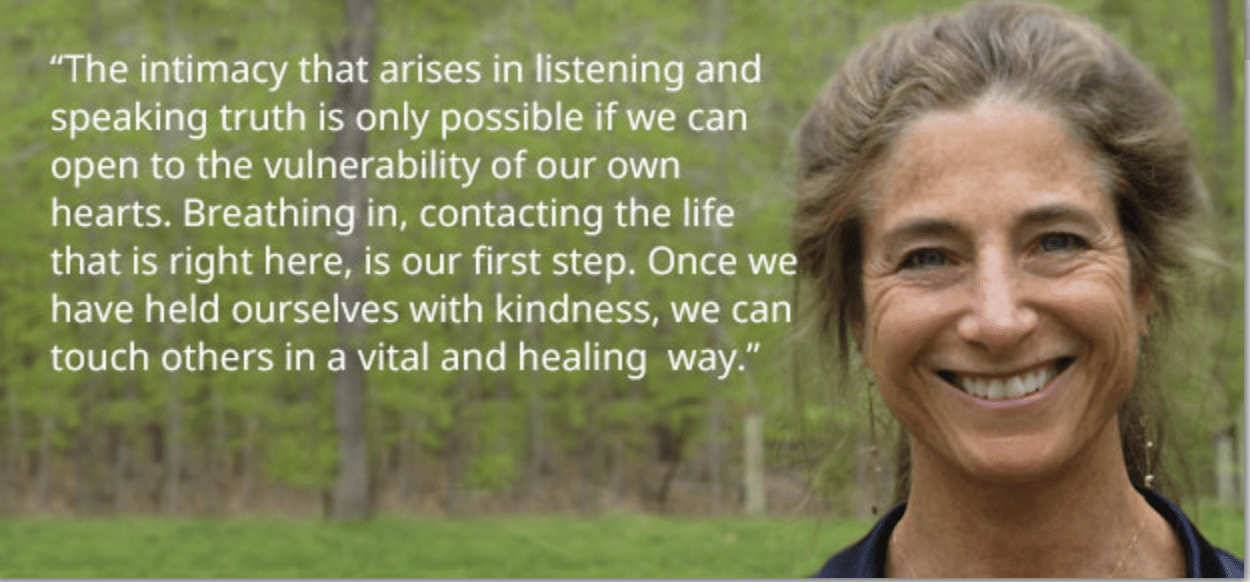
The intimacy that arises in listening and speaking truth is only possible if we can open to the vulnerability of our own hearts. Breathing in, contacting the life that is right here, is our first step. Once we have held ourselves with kindness, we can touch others in a vital and healing way. – Tara Brach

Our most fundamental sense of well-being is derived from the conscious experience of belonging. Relatedness is essential to survival. When we feel part of the whole, connected to our bodies, each other, and the living Earth, there is a sense of inherent rightness, of being wakeful and in love. The experience of universal belonging is at the heart of all mystical traditions. In realizing non-separation, we come home to our primordial and true nature.

The Buddha taught that suffering arises out of feeling separate. To the degree that we identify as a separate self, we have the feeling that something is wrong, something is missing. We want life to be different from the way it is. An acute sense of separation-living inside of a contracted and isolated self-amplifies feelings of vulnerability and fear, grasping and aversion. Feeling separate is an existential trance in which we have forgotten the wholeness of our being.

Never in the history of the world has the belief in a separate self been so exaggerated and prevalent as it is now in the twenty-first century in the West. In contrast to Asian and other traditional societies, our distinctive mode of identification is as individuals, without stable pre-existing contexts of belonging to families, communities, tribes or religious groups. Our desperate efforts to enhance and protect this fragile self have caused an unprecedented degree of severed belonging at all levels in our society. In our attempts to dominate the natural world, we have separated ourselves from the Earth. In our efforts to prove and defend ourselves, we have separated ourselves from each other. Managing life from our mental control towers, we have separated ourselves from our bodies and hearts.

With our Western experience of an extremely isolated self, we exemplify fully what the Buddha described as self-centered suffering. If we identify as a separate self, we become the background “owner” of whatever occurs. Ajahn Buddhadasa, a twentieth-century Thai meditation master, describes this conditioning to attach an idea of self to experience as “I-ing” and my-ing. Life happens emotions well up, sensations arise, events come and go and we then add onto the experiences that they are happening to me, because of me.

When inevitable pain arises, we take it personally. We are diagnosed with a disease or go through a divorce, and we perceive that we are the cause of unpleasantness (we’re deficient) or that we are the weak and vulnerable victim (still deficient). Since everything that happens reflects on me, when something seems wrong, the source of wrong is me. The defining characteristic of the trance of separation is this feeling and fearing of deficiency.

Both our upbringing and our culture provide the immediate breeding ground for this contemporary epidemic of feeling deficient and unworthy. Many of us have grown up with parents who gave us messages about where we fell short and how we should be different from the way we are. We were told to be special, to look a certain way, to act a certain way, to work harder, to win, to succeed, to make a difference, and not to be too demanding, shy or loud. An indirect but insidious message for many has been, “Don’t be needy.” Because our culture so values independence, self-reliance and strength, even the word needy evokes shame. To be considered as needy is utterly demeaning, contemptible. And yet, we all have needs-physical, sexual, emotional, spiritual. So the basic message is, “Your natural way of being is not okay; to be acceptable you must be different from the way you are.”

Almost two decades ago, author John Bradshaw and others enlarged our cultural self-awareness by calling attention to the crippling effect of shame. Since then, many have recognized the pervasive presence of shame much as we might an invisible toxin in the air we breathe. Feeling “not good enough” is that often unseen engine that drives our daily behavior and life choices. Fear of failure and rejection feeds addictive behavior. We become trapped in workaholism-an endless striving to accomplish-and we overconsume to numb the persistent presence of fear.

In the most fundamental way, the fear of deficiency prevents us from being intimate or at ease anywhere. Failure could be around any corner, so it is hard to lay down our hypervigilance and relax. Whether we fear being exposed as defective either to ourselves or to others, we carry the sense that if they knew . . . , they wouldn’t love us. A winning entry in a Washington Post T-shirt contest highlights the underlying assumption of personal deficiency that is so emblematic of our Western culture: “I have occasional delusions of adequacy.”

During high school, I consciously struggled with not liking myself, but during college I was distressed by the degree of self-aversion. On a weekend outing, a roommate described her inner process as “becoming her own best friend.” I broke down sobbing, overwhelmed at the degree to which I was unfriendly toward my life. My habit for years had been to be harsh and judgmental toward what I perceived as a clearly flawed self. My attachment to self-improvement transferred itself into the domain of spiritual practice. While I realized at the time that kindness was intrinsic to the spiritual path, in retrospect it is clear how feeling unworthy directly shaped my approach to spiritual life.

I moved into an ashram and spent twelve years trying to be more pure-waking up early, doing hours of yoga and meditation, organizing my life around service and community. I had some idea that if I really applied myself, it would take eight or ten years to awaken spiritually. The activities were wholesome, but I was still aiming to upgrade a flagging self. Periodically I would go to see a spiritual teacher I admired and inquire, “So, how am I doing? What else can I do?” Invariably these different teachers responded, “Just relax.” I wasn’t sure what they meant, but I didn’t think they really meant “relax.” How could they? I clearly wasn’t “there” yet.

During a six-week Buddhist meditation retreat, I spent at least twelve days with a stomach virus. Not only was there physical discomfort, but I found that I made myself “wrong” for being sick. Having already struggled with chronic sickness, this retreat made it clear just how harshly I had been relating to myself. Sickness had become another sign of personal deficiency. My assumption was that I didn’t know how to take care of myself. I feared that being sick reflected unworthiness and a basic lack of spiritual maturity.

In one of the evening dharma talks, a teacher said, “The boundary to what we can accept is the boundary to our freedom.” For me this rang incredibly true. I had been hitting that boundary repeatedly, contracted by the almost invisible tendency to believe something was wrong with me. Wrong if I was fatigued, wrong if my mind was wandering, wrong if I was anxious, wrong if I was depressed. The overlay of shame converted unpleasant experiences into a verdict on self. Pain turned into suffering. In the moment that I made myself wrong, the world got small and tight. I was in the trance of unworthiness.

Several years ago, at a meeting with a group of Western teachers, the Dalai Lama expressed astonishment at the degree of self-aversion and feelings of unworthiness reported by Western students. I know many friends and students who have found, as I did, that even after decades of spiritual practice, they are still painfully burdened by feelings of personal deficiency. Many assumed that meditation alone would take care of it. Instead, they found that deep pockets of shame and self-aversion had a stubborn way of persisting over the years.

Carl Jung describes a paradigm shift in understanding the spiritual path: Rather than climbing up a ladder seeking perfection, we are unfolding into wholeness. We are not trying to transcend or vanquish the difficult energies that we consider wrong-the fear, shame, jealousy, anger. This only creates a shadow that fuels our sense of deficiency. Rather, we are learning to turn around and embrace life in all its realness-broken, messy, vivid, alive.

Yet even when our intention in spiritual practice is to include the difficult energies, we still have strong conditioning to resist their pain. The experience of shame-feeling fundamentally deficient-is so excruciating that we will do whatever we can to avoid it. The etymology of the word shame is “to cover.” Rather than feel the rawness of shame, we develop life strategies to cover and compensate for its presence. We stay physically busy and mentally preoccupied, absorbed in endless self-improvement projects. We numb ourselves with food and other substances. We try to control and change ourselves with self-judgment or relieve insecurity by blaming others. We are so sufficiently defended that we can spend years meditating and never really include in awareness the feared and rejected parts of our experience.

Often those who feel plagued by not being good enough are drawn to idealistic cosmologies that highlight the sense of personal deficiency but offer the possibility of becoming a dramatically different person. The quest for perfection is based on the assumption that we are faulty and must purify and transcend our lower nature. This perception of spiritual hierarchy, of progressing from a lower to a higher self, can be found in elements of most Western and Eastern religions.

When we are in the process of trying to ascend, we never arrive and always feel spiritually insufficient. This was clearly the case during my first years of practice in pursuit of becoming a more perfect yogi. The temporary and passing states of peace or rapture were never enough to soothe my underlying sense of unworthiness. I felt continuously compelled to do more. An alternative face of such insecurity is spiritual pride. The very accomplishments-like improved concentration or periods of bliss-if owned by the self, reinforce a sense of a deficient self that is moving up the ladder. With either pride or shame, our awareness is identified as an entity that is separate and afraid of failure.

In my own unfolding, as well as with friends, clients and dharma students, an intentional spotlight on shame and unworthiness has been enormously revealing. Many people have told me that when they realize how pervasive their self-aversion is and how long their life has been imprisoned by shame, it brings up a sense of grief as well as life-giving hope. Fear of deficiency is a prison that prevents us from belonging to our world. Healing and freedom become possible as we include the shadow-the unwanted, unseen and unfelt parts of our being-in a wakeful and compassionate awareness.

* * *

For a child to feel belonging, he or she needs to feel understood and loved. We each feel a fundamental sense of connectedness when we are seen and when what is seen is held in love. We habitually relate to our inner life in the same way that others attended to us. When our parents (and the larger culture) don’t respond to our fears, are too preoccupied to really listen to our needs or send messages that we are falling short, we then adopt similar ways of relating to our own being. We disconnect and banish parts of our inner life.

Meditation practices are a form of spiritual reparenting. We are transforming these deeply rooted patterns of inner relating by learning to bring mindfulness and compassion to our life. An open and accepting attention is radical because it flies in the face of our conditioning to assess what is happening as wrong. We are deconditioning the habit of turning against ourselves, discovering that in this moment’s experience nothing is missing or wrong.

The trance of unworthiness, sustained by the movement of blaming, striving and self-numbing, begins to lift when we stop the action. The Buddha engaged in his mythic process of awakening after coming to rest under the bodhi tree. We start to cut through the trance in the moment that we, like the Buddha, discontinue our activity and pay attention. Our willingness to stop and look-what I call the sacred art of pausing-is at the center of all spiritual practice. Because we get so lost in our fear-driven busyness, we need to pause frequently.

The Buddha realized his natural wisdom and compassion through a night-long encounter with the forces of greed, hatred and delusion. We face the shadow deities by pausing and attending to whatever presents itself-judgment, depression, anxiety, obsessive thinking, compulsive behavior. Because shame and fear often are not fully conscious, we can deepen this attention by inquiring into what is happening. Caring self-inquiry invites the habitually hidden parts of our being into awareness.

If I pause in the midst of feeling even mildly anxious or depressed and ask, “What am I believing?” I usually discover an assumption that I am falling short or about to fail in some way. The emotions around this belief become more conscious as I further inquire, “What wants attention or acceptance in this moment?” Frequently I find contractions of fear under the story of insufficiency. I find that the trance is sustained only when I reject or resist experience. As I recognize the mental story and open directly to the bodily sense of fear, the trance of unworthiness begins to dissolve.

There are times that the grip of fear and shame is overt and vicelike. At a retreat I led a few years ago a young man named Ron came into an interview with me and announced that he was the most judgmental person in the world. He went on to prove his point, describing how scathing he was toward his every thought, mood and behavior. When he felt back pain, he concluded that he was an “out of shape couch potato, not fit for a zafu.” When his mind wandered, he concluded he was hopeless as a meditator. During the lovingkindness meditation, he was disgusted to find that his heart felt like a cold stone. In approaching an interview with me, he felt caught in the clutch of fear, embarrassed that he would be wasting my time. While others were not exempt, his most constant barrage of hostility was directed at himself. I asked him if he knew how long he had been turning so harshly on himself. He paused for quite a while, his eyes welling up with tears. It was for as long as he could remember. He had joined in with his mother, relentlessly badgering himself and turning away from the hurt in his heart.

The recognition of how many moments of his life had been lost to self-hatred brought up a deep sorrow. I invited him to sense where his body felt the most pain and vulnerability. He pointed to his heart, and I asked him how he felt toward his hurting heart at that moment. “Sad,” he responded, “and very sorry.” I encouraged him to communicate that to his inner life-to put his hand on his heart and send the message, “I care about this suffering.” As he did so, Ron began to weep deeply.

In Buddhist meditation, a traditional compassion practice is to see suffering and offer our prayer of care. Thich Nhat Hanh suggests that when we are with someone who is in pain, we might offer this deeply healing message: “Darling, I care about your suffering.” We rarely offer this care or tenderness to ourselves. We are definitely not used to touching ourselves, bringing the same tenderness that we might to stroking the cheek of a sleeping child, and gently placing a hand on our own cheek or heart. For the remaining days of the retreat, this was Ron’s practice. When he became aware of judging, he would consciously feel the vulnerability in his body-the place that for so long had felt pushed away, frightened, rejected. With a very gentle touch, he would place his hand on his heart and send the prayer of care. Ron was sitting in the front of the meditation hall, and I noticed that his hand was almost always resting on his heart.

When we met before the closing of the retreat, Ron’s whole countenance was transformed. His edges had softened, his body was relaxed, his eyes were bright. Rather than feeling embarrassed, he seemed glad to see me. He said that the judgments had been persistent but not so brutal. By feeling the woundedness and offering care, he had opened out of the rigid roles of judge and accused. He went on to tell me something that had touched him deeply. When he had been walking in the woods, he passed a woman who was standing still and crying quietly. He stopped several minutes later down the trail and could feel his heart hold and care for her sadness. Self-hatred had walled him off from his world. The experience of connection and caring for another was the blessing of a heart that was opening.

The Buddha said that our fear is great, but greater yet is the truth of our connectedness. Whereas Ron was able to rediscover connection and loosen the trance of unworthiness by tenderly offering kindness to his wounds, we might feel too small, too tight and aversive to open to the pain that is moving through us. At these times it helps to reach out, to discover an enlarged belonging through our friends, sangha, family and the living Earth. A man approached the Dalai Lama and asked him how to deal with the enormous fear he was feeling. The Dalai Lama responded that he should imagine he was in the lap of the Buddha.

Any pathway toward remembering our belonging to this world alleviates the trance of separation and unworthiness. After his night under the bodhi tree, the Buddha was very awake but not fully liberated. Mara had retreated but not vanished. With his right hand, the Buddha touched the ground and called on the Earth goddess to bear witness. By reaching out and honoring his connectedness to all life, his belonging to the web of life, the Buddha realized the fullness of freedom.

We are not walking this path alone, building spiritual muscles, climbing the ladder to become more perfect. Rather, we are discovering the truth of our relatedness through belonging to these bodies and emotions, to each other, and to this whole natural world. As we realize our belonging, the trance of unworthiness dissolves. In its place is not worthiness; that is another assessment of self. Rather, we are no longer compelled to blame or hide or fix our being. When we turn and embrace what has felt so personal, we awaken from feelings of separateness and find that we are in love with all of life.
The link to this article: https://www.tarabrach.com/articles-interviews/inquiring-trance

Tara Brach is a teacher and founder of the Insight Meditation Community of Washington, D.C.,and teaches throughout the United States and Europe. She is a clinical psychologist and author of Radical Acceptance: Embracing Your Life with the Heart of a Buddha,True Refuge: Finding Peace and Freedom in Your Own Awakened Heart, and Radical Compassion: Learning to Love Yourself and Your World with the Practice of R.A.I.N.

More resources about self-belonging including Tara’s article can be found on my website.

Deliberate Practice does not equal Automaticity

My previous post provided teachers with practical steps to become more reflective. Reflecting on one’s accomplishments and areas for improvement is all well and good, but only half the way to becoming an effective teacher. The other half is deliberate practice-using reflection to change what we do. In fact, the keynote speaker at Education 2020 Conference in Abu Dhabi, UAE, Dr. Linda Price, made an interesting observation about the word reflective. She noted that ‘reflective’ means to ponder or think about one’s actions without necessarily acting on them, but ‘reflexive’ implies using reflection to change what we do. So how can we be more reflexive after reflecting?
According to the Oxford Dictionary, deliberate means, “done consciously and intentionally; fully considered, not impulsive”. In an article entitled, “Deliberate Practice: How to Develop Expertise”, Dr. Richard Jenkins (2012) states, “the best practice demands that the learner be attentive to his or her errors, weaknesses and deficiencies, and consciously work to remedy them”. Dr. Robert Marzano (2012) relates the success of several famous musicians, athletes and businessmen to their perseverance at practicing a specific skill (p. 7) and become more proficient. “Research has shown us time and again that the more we utilize certain neural pathways for building skills – such as throwing a ball or multiplying by fives or recalling all fifty state capitals – the more effectively we ingrain those patterns in our brains.” (Jenkins, 2012) Jenkins has a point, but we must be careful not to associate expertise with ‘automaticity’ of the skill (Marzano, 2012, p. 7). I disagree with Jenkins about the skill becoming automatic. In education, the art of deliberate practice is not in making the skill automatic, instead we must always be mindful of the action; we must think about our thinking related to our increasing expertise in a skill. In fact, monitoring all students in the classroom requires a deliberate mindset. Once we begin to do things automatically, we are less likely to pay attention to what is going on around us. For example, have you ever gone through a traffic light and then wondered if it was green? Once a behavior is automatic, it is easier for our mind to wander.
Being mindful and deliberate about classroom practice allows teachers to continue growing and learning; even master teachers. The bottom line is – teachers must be reflexive – focus on student needs and plan/practice deliberately; the most effective way to increase their students’ achievement.
Do you reflect and act, or reflect and intend to act? Feedback welcome!

Self-reflection: First Step to Effective PD

In the first post of my series about effective professional development, I discussed the concept of training transfer. In today’s post, I will focus on the first step to training transfer: self-reflection. More specifically, I will focus on the steps to becoming a reflective teacher. Recently, while conducting professional development workshops, I discovered that reflection is the first and most important step toward changing and improving what we do in the classroom each day. I don’t suppose that the idea of reflecting on one’s life is new or different, especially at this time of year when we are entering a new year and reflecting on what we accomplished in the past year.

The Merriam Webster online dictionary (2013) defines reflection as a “thought, idea, or opinion formed or a remark made as a result of meditation’ or ‘consideration of some subject matter, idea, or purpose’. In theory, this concept is quite simple; a teacher considers his/her lessons on a particular day and thinks about whether they were successful or not. In reality, this is much more difficult in practice. Teachers are busy people and at the end of the day, the last thing they want to do is think about how their day went. And even if teachers take the time to reflect on their day, how do they create an action plan? For reflection to be effective, teachers must become deliberate in their planning and daily instruction, or outline clear steps to make changes in the classroom. Here’s a step-by-step guide to reflection that leads to action.

1. At the end of each day, set aside 10-15 minutes to journal. The journal entries could be a set of bulleted items that are divided into “successful” and “not so successful”, or a narrative that reflects on what went well and what missed the mark. Note that I did not use the word “failure” since there is always something positive that results from a lesson.
2. Look at each comment or bullet point and decide why the lesson was successful or not so successful (give yourself focused feedback). Reflect on whether you used a strategy at the wrong time, or if you didn’t know what strategy to use.
3. Decide on “next steps”; how can you do the lesson differently/better next time? Do you need to learn a strategy suited to that particular situation/lesson?
4. Come up with a plan and implement it. Ask yourself, ‘How can I accomplish this?’ Three quick ways are: ask a colleague, read more about the topic, or ask an expert.
5. After you try the strategy, reflect again.
6. Get into the habit of reflecting regularly. Only then will your practice become deliberate.
I will say more about deliberate practice in my next post.

Why not make daily reflection one of your New Year’s resolutions.

References:
Marzano, R. M., Boogren, T., Heflebower, T., Kanold-McIntyre, J. & Pickering, D. (2012).Becoming a Reflective Teacher. Marzano Research Laboratory: Bloomington, IN